Don't Blame Your Timing in a Rhythm Game Until You Check Lag
Published
A rhythm game grades when you press. A music game just lets you play along. Both put a song on and ask you to move to it. Only one of them keeps score down to the millisecond. We build a music game of our own, and the gap between those two ideas is why so many players think their timing is bad when their headphones are the real problem.
What You Need
- A rhythm game asks you to hit inputs in time with a song and judges how close you got
- In osu!mania, a Perfect hit has to land within 16 milliseconds of the note
- Plain Bluetooth audio can run 100 to 150 milliseconds late, which is far wider than that window
- Fix the lag first, then set the game's audio offset, then judge your hands
- Music games without a timing judge, like Chip Jam Session, can't punish you for lag at all
The Line Between a Rhythm Game and a Music Game
Wikipedia calls the rhythm game a type of music action game that challenges your sense of rhythm. You press buttons, step on pads or swing at targets at set moments in a song. The screen shows what to hit. Points come from accuracy and from staying in sync with the beat.
That judge is the whole point. It's what makes Dance Dance Revolution a rhythm game and a karaoke night something else.
A music game is the wider family. It uses a song as the stage, but it may not grade your timing at all. Some games let you build a track. Some let you catch notes as they fall. Fans argue about where the line sits for games like Geometry Dash, where levels are built to the music but you're scored on not crashing.
A simple test settles most of it. Ask what happens when you're a little late. If the game tells you, with a Good instead of a Perfect, it's a rhythm game. If nothing changes, it's a music game with a beat.
How a Rhythm Game Grades Every Hit
Every note has a target time. When you press, the game measures how far off you were and drops you into a grade. Those grades are called judgments, and each one has a window.
osu!mania is one of the few games that publishes its windows. Its wiki lists the judgment windows in milliseconds. At the easiest setting, a Perfect has to land within 16 milliseconds of the note. A Great allows 64. A miss starts past 188.
Sixteen milliseconds is short. It's about one frame on a 60 Hz screen.
Those windows also get tighter as the difficulty goes up. The wiki gives the math. Every step of the Overall Difficulty setting takes 3 milliseconds off each window except Perfect, which stays at 16.
So the skill isn't reacting to a note. Reacting is too slow. The skill is feeling the beat and pressing on it, the way a drummer does. That only works if the sound you hear lines up with the note you see.
The Main Kinds of Rhythm Games
The genre is older than most people think. Splice traces the history of rhythm games back to Dance Aerobics in 1987, where you stepped on Nintendo's Power Pad. PaRappa the Rapper followed in 1996, and many fans call it the first true rhythm game.
- Note highway games. Notes scroll down lanes toward a line, and you hit the matching key. osu!mania and StepMania work this way.
- Instrument games. A plastic guitar or drum kit stands in for the real thing. Guitar Hero arrived in 2005 and Rock Band in 2007.
- Dance games. You step on a pressure pad or follow moves on camera. Dance Dance Revolution started this in 1998.
- Tap games. Circles or notes pop up on a phone or tablet screen, and you tap them on the beat.
- VR games. You swing at blocks that fly toward you in time with the track. Beat Saber is the big one.
- Hybrid games. The beat drives another genre, like a shooter or a dungeon crawler, so you move or attack on the rhythm.
The money side had a wild swing. Wikipedia reports rhythm game sales of $1.47 billion in 2008, falling to $700 million in 2009. That crash is why the genre left store shelves. It didn't leave players. Phones, VR headsets and free PC games kept it going.
Fix the Lag Before You Blame Your Hands
Lag in a rhythm game comes from three places. The screen can show the note late. The sound can reach your ears late. Your press can reach the game late. If the sound is late, you'll press late every time and never know why.
Bluetooth is the usual suspect. An audioXpress piece from June 2023 puts the common SBC codec at about 100 to 150 milliseconds and AAC at about 150 to 200. Newer LE Audio with the LC3 codec cuts that to about 20 to 30.
Even the browser has a delay. MDN's page on outputLatency says it varies with the platform and the hardware.
Work through it in this order.
- Go wired. Plug in headphones or use the speakers built into the device. The Sonolus wiki on audio and input offsets warns against Bluetooth headphones for this reason.
- Turn on game mode. Many TVs add delay to smooth the picture. Game mode skips that work.
- Close the heavy stuff. Extra browser tabs and downloads can make a game drop frames.
- Set the audio offset. Watch a well synced chart and see if notes hit the line with the music. If they drift, move the audio offset until they match.
- Then set the input offset. Play an easy song and look at your accuracy after. Sonolus says to add your average error to the input offset. If you're 20 milliseconds late on average, add 20.
- Check your keyboard. Cheap keyboards can drop keys when you press several at once. The guide to two player games on one computer has a quick test for it.
Order matters. If you calibrate while still on Bluetooth, the offset hides the lag instead of fixing it. Your hit sounds will still come late, and the offset breaks the day you switch headphones.
osu! keeps a universal offset in its audio options, plus an offset wizard. Most serious rhythm games have something like it. Look for it before you change anything else.
Where Chip Jam Session Fits
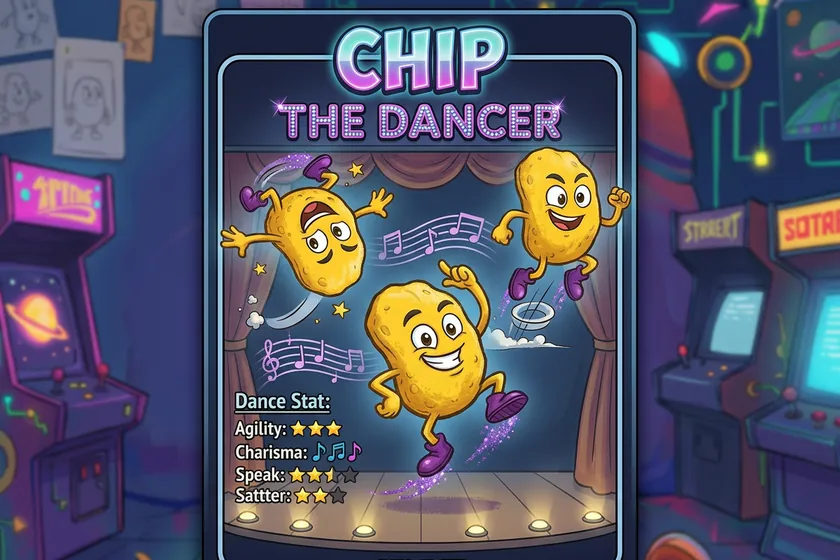
Chip Jam Session is the VanillaBits music game, and it sits on the gentle side of the line. Chip is a dancing potato on a neon floor. Notes fall from the top, and you slide Chip left and right with the arrow keys, A and D, or a drag to catch them.
The numbers come straight from the game's code. The beat runs at 112 beats a minute, so one beat lasts about 536 milliseconds. Every 8 catches in a row raises your groove level, up to 4. Each level adds half again to your points, so a full groove pays 3 times as much. Fill the Star Power meter and you get 7 seconds of double points.
What the code leaves out matters more. It never grades how close you were to the beat. Notes fall at random spots, and a catch is a catch. Miss one and your combo resets, but there's no game over screen and no clock.
That makes it a good warm up. Bluetooth lag can't hurt your score, little kids can play it, and you still learn to move with a steady beat. When you want a real timing judge, a note highway game is the next step.
If you like games that are kind about timing, platformers do something close. The platformer guide explains coyote time, a hidden grace period that lets you jump a moment after you leave a ledge.
What Other Pages Miss
Most pages on this topic stop at a definition and a list of famous games. The best known one is a few years old and says the genre is past its golden era. It names headsets and keyboards to buy, but it never mentions lag or offsets.
That's the gap that matters to a new player. You can have a fine sense of rhythm and still score badly, because your earbuds add a delay six times wider than a Perfect window. A list of games won't fix that. A wired pair and two minutes in the offset menu will.
The other gap is cost. Search for rhythm games and most picks are paid, or free with ads between songs. An ad that cuts into a song breaks your flow. The page on games without ads covers where to play without them.

Short Questions
What is a rhythm game in simple words?
It's a video game where you press, tap, step or swing in time with music. The game checks how close you were to each beat and scores you on it.
What was the first rhythm game?
It depends who you ask. Dance Aerobics came out in 1987 for Nintendo's Power Pad. PaRappa the Rapper in 1996 is the one many fans call the first true rhythm game.
Can you play rhythm games with Bluetooth headphones?
You can, but plain Bluetooth often runs 100 milliseconds late or more. Wired headphones are better. If you stay on Bluetooth, set the audio offset in the game and redo it when you change headphones.
Is Geometry Dash a rhythm game?
Fans argue about it. Its levels are built to the music, so it feels like one. But it scores you on surviving the level, not on how close you hit each beat, so many players call it a platformer with a soundtrack.
Are rhythm games good exercise?
Dance games can be. Wikipedia notes studies that found Dance Dance Revolution gives an aerobic workout by heart rate, and that dancing games burn more calories than walking on a treadmill. Button games are a workout for your fingers only.
Follow VanillaBits in Google Search
Also on the Blog
- Cozy games vs casual games
- What Is a Platformer Game?
- What is a match 3 game?
- Where to play games without ads
Supporting Links
- Wikipedia, Rhythm game, opened October 2026
- Splice, Shakeil Greeley, The fantastic history of rhythm games, November 22, 2019, opened October 2026
- osu! wiki, Judgement in osu!mania, opened October 2026
- osu! wiki, Options, opened October 2026
- Sonolus wiki, Offsets, opened October 2026
- audioXpress, Morag Agmon, Low Latency Gaming and Hearing Aids, June 1, 2023, opened October 2026
- MDN Web Docs, AudioContext outputLatency, opened October 2026
- VanillaBits, Chip Jam Session game code, opened October 2026
We make every VanillaBits game by hand in Hemet, California. They're free in your browser, with no ads, not now and not ever.