What Is a Platformer Game?
Published
A platformer is a game where you run and jump across platforms, gaps and enemies to reach the end of a level. Donkey Kong from 1981 is widely called the first one, and Super Mario Bros. from 1985 set the model most still follow. The feel of every jump comes down to a few numbers, and we show you the real ones from our own game below.
What You Need
- The quick test is jumping as the main action, falls that cost you, and levels that go somewhere
- The genre runs from 2D classics to 3D worlds, precision games and metroidvanias
- In our game a jump rises 180 pixels and lasts 0.78 seconds
- Good platformers hide help like coyote time and jump buffering
- For kids, look for safe respawns, touch buttons and no ads
The Quick Test for a Platformer
We make browser games, and one of them is a platformer. So we spend a lot of time on one question. What makes a game a platformer and not just an action game?
We use a short test. Ask three things.
- Is jumping the main thing you do? Not a move you use now and then. The thing you do every few seconds.
- Can you fall? Gaps, pits, water or lava should cost you something when you miss.
- Do the levels go somewhere? You move from a start to an end, a goal or a boss.
Three yes answers and it is a platformer. Wikipedia's platformer article puts it the same way. The core goal is to move your character from point to point in a world full of platforms. It also lists the other name, jump 'n' run, which says it in three words.
The name comes from the floors you jump between. Shigeru Miyamoto first called Donkey Kong a running, jumping and climbing game. Wikipedia says platform game became the usual term by 1989, pushed by the UK game press.
A Short History in Ten Games
Most pages on this topic say the genre is old and leave it there. These are the games that moved it forward, with the year each one landed. Dates come from Wikipedia and from Activision Blizzard's brief history of the platformer, published June 14, 2023.
| Year | Game | What it added |
|---|---|---|
| 1980 | Space Panic | Ladders and floors, but no jump. Sometimes called the first. |
| 1981 | Donkey Kong | The first jump over gaps and hazards. Widely called the first platformer. |
| 1981 | Jump Bug | Scrolling levels, about five months after Donkey Kong |
| 1982 | Pitfall! | Side scrolling across screens with jumping and climbing |
| 1985 | Super Mario Bros. | Became the model for the whole genre |
| 1990 | Alpha Waves | Called the earliest true 3D platformer |
| 1995 | Jumping Flash! | The first 3D platformer on a home console |
| 1996 | Super Mario 64 | The standard most 3D platformers copied |
| 2006 | New Super Mario Bros. | Proof 2D still sold, with 30 million copies |
| 2023 | Super Mario Bros. Wonder | The first new 2D Mario since 2012 |
The middle of that story is the part people forget. Wikipedia says platformers held 15% of the game market in 1998 and fell to about 2% a few years later. Then 2D platformers rose again in the 2010s.
The Main Types of Platformers
Platformer is a big tent. Lucas Kelleher of Kelleher Bros. wrote a guide to the platformer genre that splits it by tone, combat, level shape and camera. Below is a quick map of the types, with the example each source gives.
| Type | What you mostly do | Example |
|---|---|---|
| Classic 2D | Run right, jump gaps, stomp enemies | Super Mario Bros. |
| Precision | Hard, exact jumps with quick retries | Celeste |
| 3D | Jump in a world you can turn around in | Super Mario 64 |
| Metroidvania | Explore one big map and unlock new moves | Hollow Knight |
| Puzzle | Think first, then jump | Toodee and Topdee |
| Action | Fight as much as you jump | Bionic Commando |
| Platform fighter | Knock friends off a stage | Super Smash Bros. |
Most games mix two or three of these. Our own game is a classic 2D platformer with action bits. You can stomp, punch and kick, and you can toss stars at enemies.
Inside One Jump. The Numbers From Our Own Game
No other page on this question shows you the real math behind a jump. We opened the code of Princess Genevieve's Quest in October 2026 and pulled the numbers that decide how it feels.
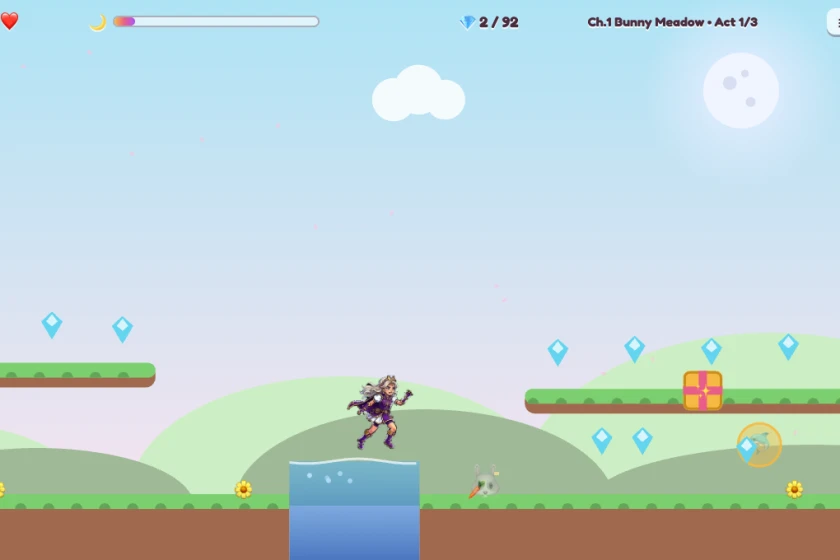
Three numbers do most of the work. Gravity pulls the princess down at 2,350 pixels per second, every second. A jump launches her up at 920 pixels per second. She runs at 330 pixels per second.
Put those together and you get the jump. She rises 180 pixels, which is almost three times her own 62 pixel height. She stays in the air for 0.78 seconds. In that time a running jump carries her 258 pixels across. Every gap in the game is built to fit inside that arc.
Change one number and the whole game changes. The jump power up multiplies launch speed by 1.32, so the jump climbs to 314 pixels. The space acts cut gravity to 45%, so a normal jump floats up to 400 pixels and hangs for 1.74 seconds. Stomping an enemy bounces her back up at 65% of a full jump.
That is why two platformers with the same art can feel so different. One feels floaty. One feels heavy. The art is the same. The gravity and jump speed are not.
The Hidden Help. Coyote Time and Jump Buffering
Good platformers quietly cheat in your favor. Maddy Thorson, who made Celeste, listed ten of these tricks in a post on Celeste and forgiveness, first shared on March 12, 2020. She says the team did not invent them. Two matter most.
- Coyote time. You can still jump for a moment after you run off a ledge.
- Jump buffering. If you press jump a little before you land, the game saves the press and jumps the moment your feet touch down.
Our game uses both. Coyote time is 0.10 seconds. The jump buffer is 0.12 seconds. At 60 frames a second, that is six or seven frames each. You will never see it. You will feel it, because jumps you were sure you missed still work.
Celeste goes further. Thorson says holding the jump button gives the top of the jump half gravity, so you get a little more time to aim your landing. It even nudges you around corners you bump your head on. Every trick has the same goal. Make the game hard without making it feel unfair.
| Trick | What it fixes | In our game |
|---|---|---|
| Coyote time | Jumping a hair too late at a ledge | Yes, 0.10 s |
| Jump buffering | Pressing jump a hair too early | Yes, 0.12 s |
| Half gravity at the peak | Landings that feel rushed | No, every jump is the same height |
| Corner nudges | Bonking a ledge corner and dropping | No |
| Safe respawn | Losing a whole level to one fall | Yes, a fall costs one heart and puts you back on a nearby platform |
Is It a Platformer? Five Tricky Cases
This is where most arguments start. Run each one through the three part test.
- The Legend of Zelda. Wikipedia's Zelda series page lists it as action adventure. Most of the games are about exploring, fighting and puzzles, not jumping gaps. Zelda II is the odd one. It used side scrolling everywhere except its top down overworld map.
- Space Panic. It has platforms and ladders but no jump. Fails test one, which is why most people hand the first platformer title to Donkey Kong.
- Bionic Commando. You cannot jump at all. You swing with a grappling arm. Kelleher still files it as an action platformer, because getting from platform to platform is the whole game.
- Super Smash Bros. A fighting game built on platforms. Kelleher calls it a platform fighter, its own branch.
- Endless runners. The hero runs by themselves and you only time the jumps. Wikipedia counts these as a platformer idea, since jumping is still the main skill.
How to Pick a First Platformer for a Kid
Many parents search this question because a kid asked for a game like Mario. This is the checklist we built our own game around.
- A fall should not mean starting over. Look for safe respawns or checkpoints. Losing a whole level to one missed jump is how young players give up.
- Levels that stay the same. Our 22 kingdoms hold 77 acts, and each act is built the same way every time you play. Kids learn the jumps and get better.
- Hidden help in the controls. Coyote time and jump buffering make a game feel fair to small hands.
- A way to play together. A turn taking mode lets a parent and kid share one screen. Our guide to 2 player games on one computer covers the setups.
- Touch buttons for tablets. Many browser platformers are keyboard only. Ours has on screen left, right and jump buttons.
- No ads and nothing to buy. An ad between levels breaks the flow. See how to find games without ads.
What Other Pages Miss
Search this question today and you get a game store list, old forum threads and a coding tutorial. Google's AI answer leans on a short glossary entry from G2A, dated September 16, 2025 and marked sponsored, that names three famous games. None of them show you a single number.
They tell you a platformer is about running and jumping. True. They skip why some jumps feel great and others feel cheap. That comes down to gravity, launch speed and a few tenths of a second of hidden help. Now you know what to look for, and you can feel it the next time you play.
Short Questions
What is classed as a platform game?
A game where jumping between platforms is the main thing you do, where a missed jump costs you something, and where levels move toward a goal. Running and jumping is the core, so it is also called a jump 'n' run.
What was the first platformer?
Donkey Kong from 1981 is widely called the first platformer, because it was the first game that let you jump over gaps and hazards. Space Panic from 1980 is sometimes named, but it had ladders and no jump.
Is Zelda a platformer?
Not by the usual test. Wikipedia lists The Legend of Zelda as an action adventure series, built on exploring, fighting and puzzles. Zelda II is the closest, since it used side scrolling outside its overworld map.
What is coyote time in games?
Coyote time lets you jump for a split second after you run off a ledge. Celeste uses it, and Princess Genevieve's Quest gives you 0.10 seconds of it.
What is the difference between 2D and 3D platformers?
A 2D platformer is seen from the side and you move left, right, up and down. A 3D platformer lets you move in every direction with a camera you can turn. Super Mario Bros. set the 2D model in 1985 and Super Mario 64 set the 3D one in 1996.
Is there a free platformer with no ads?
Yes. Princess Genevieve's Quest on VanillaBits is free in the browser, with no ads and nothing to buy. It has 22 kingdoms, touch buttons and a two player tag team mode.
Follow VanillaBits in Google Search
Supporting Links
- Wikipedia, Platformer, accessed October 2026
- Activision Blizzard newsroom, Eric Alt, A brief history of the platformer, June 14, 2023
- Maddy Thorson, Celeste and Forgiveness, April 25, 2022
- Kelleher Bros., Lucas Kelleher, Defining the Platformer genre, March 4, 2024
- Wikipedia, The Legend of Zelda, accessed October 2026
- G2A News, Ida Kasprzycka, What Is a Platformer Game?, September 16, 2025
- VanillaBits, Princess Genevieve's Quest game code, accessed October 2026
Also on the Blog
VanillaBits is a small ad free arcade made in Hemet, California. Every game is free to play in your browser.